Car Pulling to One Side After an Accident: Alignment, Suspension, or Frame Damage?
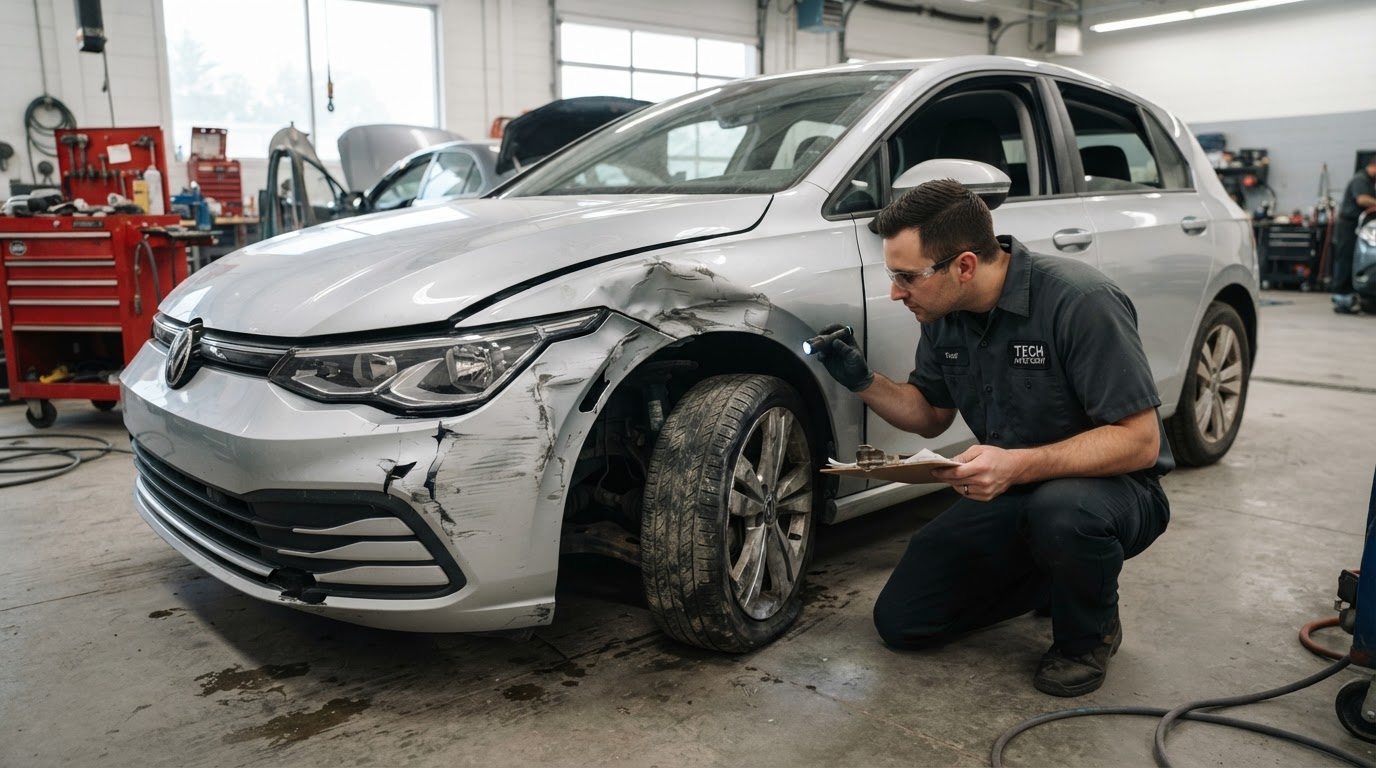
If your car started pulling left or right after an accident, the cause may be more than wheel alignment. A collision can affect tires, wheels, steering components, suspension parts, or the vehicle's structure. The right repair depends on identifying what actually changed during the impact — not on assuming one specific cause.
A vehicle pulling after an accident may be caused by:
- Tire or wheel damage
- Alignment changes
- Bent suspension components
- Steering system damage
- Subframe or mounting damage
- Structural collision damage
These are possible causes, not a diagnosis. Only an in-person assessment of the specific vehicle can identify what changed. If the vehicle has significant steering changes, tire rubbing, damaged wheels, or difficulty maintaining control, avoid driving it until it has been professionally assessed.
Why Is My Car Pulling to One Side After an Accident?
A collision can change how the wheels, steering system, or suspension components are positioned or how they function. When a wheel is pushed inward or outward, a steering link is bent, or a mounting point shifts, the vehicle may no longer track straight — and that can show up as pulling, drifting, or an off-center steering wheel.
Pulling can also have non-collision causes. A tire with low pressure, a mismatched or worn tire, or a tire condition issue can all make a vehicle pull in ways that have nothing to do with the accident. The point of a collision assessment is to separate accident-related damage from other factors so the correct parts are repaired — not to assume every symptom is frame damage.
Does My Car Just Need a Wheel Alignment?
Sometimes — but not always. A wheel alignment adjusts the angles at which the wheels sit relative to the vehicle and to each other. The three primary alignment angles are:
- Camber — the inward or outward tilt of the wheel when viewed from the front
- Caster — the forward or rearward tilt of the steering axis when viewed from the side
- Toe — whether the wheels point inward or outward when viewed from above
When the components are undamaged and adjustment is possible within the vehicle's range, an alignment can correct wheel-angle issues and restore straight tracking. But an alignment cannot properly correct bent, broken, or displaced components — adjusting the angles on a damaged part does not repair the part.
For that reason, an alignment is not automatically the first repair step after a collision. If the impact affected a steering or suspension component, the damaged part generally needs to be identified and addressed before an alignment can hold. Running an alignment over bent parts can hide the underlying damage rather than fix it.
Alignment Problem vs. Suspension Damage vs. Frame Damage
Pulling, drifting, and an off-center steering wheel can come from several different kinds of damage, and the symptoms overlap. A professional assessment is what separates them — this table is not a diagnostic checklist that definitively identifies the damaged component.
| Possible issue | What it involves | Why assessment matters |
|---|---|---|
| Wheel alignment | Wheel-angle settings | May require adjustment |
| Tire or wheel damage | Tire or wheel condition | May require repair or replacement |
| Suspension damage | Control arms, struts, links, mounting areas | Damaged components may require replacement |
| Steering damage | Tie rods or other steering components | Can affect vehicle control |
| Structural damage | Body structure or mounting geometry | May require collision-specific measurement and repair |
* Symptoms can overlap, and a single symptom does not prove which component is damaged. An in-person assessment is the reliable way to know.
Can a Minor Accident Cause Suspension Damage?
Yes, in some cases. Even a collision with limited visible body damage can involve a wheel or suspension impact. Common examples include:
- Hitting a curb
- Another vehicle striking a wheel
- Side-impact collisions near a wheel
- Front-corner collisions that reach the wheel area
Not every minor accident causes suspension damage. A light parking lot scrape may be limited to the body panels. But when an impact reaches the wheel — directly or through a nearby panel — the force can transfer into the suspension, and that damage may not be visible from outside.
What Happens If a Control Arm or Tie Rod Is Bent?
Several steering and suspension components work together to keep the wheels positioned and responsive to the steering wheel:
- Control arms connect the wheel assembly to the vehicle's structure and allow the suspension to travel
- Tie rods link the steering rack to the steering knuckle and help steer the wheel
- Ball joints allow pivoting between components while holding them together
- Struts combine a spring and shock absorber to support the wheel and absorb impact
- Steering knuckles hold the wheel hub and connect to the steering and suspension parts
When one of these components is bent or shifted, it can change wheel positioning, steering response, or alignment — which may show up as pulling, an off-center steering wheel, or unusual handling. These are repairs that a collision repair facility can assess and, where appropriate, address. We do not provide DIY repair instructions; steering and suspension components affect vehicle control and should be inspected professionally.
Why Is My Steering Wheel Crooked After an Accident?
An off-center steering wheel after a collision can come from several related issues:
- Alignment changes to the wheel angles
- Steering linkage damage, such as a bent tie rod
- Suspension damage that shifted a wheel's position
- A change in wheel positioning from the impact
A crooked steering wheel does not automatically prove frame damage. It can be an alignment issue, a steering component issue, or a suspension issue — and the only way to know which is to assess the actual vehicle. If the steering wheel was centered before the collision and is now off, that is a sign worth having checked.
Can Hitting a Curb Damage My Suspension?
Yes. A curb impact can affect the tire, the wheel, the alignment, and the suspension or steering components — all from a single hit. The wheel takes the force first, but that force can transfer inward into the parts that locate the wheel.
Visible wheel damage does not always reveal the full extent of the impact. A wheel may look fine while a control arm, tie rod, or steering knuckle behind it has been bent — which is why a curb impact that changes how the vehicle drives is worth assessing even when the wheel looks intact. If the car pulls, the steering wheel is off, or the vehicle drives differently after hitting a curb, have it inspected.
Can a Side-Impact Accident Change Wheel Alignment?
It can, depending on where the impact occurred. A side-impact collision near a wheel can push the wheel or the components that locate it, which may change suspension geometry or shift a mounting point. When that happens, the vehicle may pull, the steering wheel may sit off-center, or the handling may feel different.
Not every sideswipe changes alignment. A side impact that is limited to a body panel away from the wheel area may not affect the suspension at all. The relevance depends on where the impact reached, which is part of what a collision assessment checks.
What Are the Signs of Suspension Damage After an Accident?
Symptoms that may point toward suspension or steering damage after a collision include:
- The vehicle pulling to one side
- The steering wheel sitting off-center
- Unusual vibration through the steering wheel or body
- New clunking, rattling, or knocking sounds
- Tire rubbing against a fender or liner
- Visible changes in wheel position or stance
- Abnormal handling or a change in steering feel
- Uneven tire wear developing after the incident
None of these symptoms alone proves a particular type of damage. Pulling can be a tire, alignment, or suspension issue; vibration can come from a wheel or a bent component. An assessment is what connects the symptom to the actual cause.
How Do I Know If My Car Has Frame Damage?
Vehicle structure varies. Many modern passenger vehicles use a unibody construction, where the body and frame are a single integrated structure. Others use a body-on-frame design, where the body is mounted to a separate frame. The way structural damage is assessed differs between the two.
Indications that may warrant a structural assessment include:
- Significant changes in panel gaps or panel alignment
- Visible changes in wheel position relative to the body
- Door, hood, or trunk fit problems that were not there before
- Structural deformation visible near the impact
- Collision damage near a suspension or steering mounting point
A vehicle pulling does not automatically mean the frame is bent. Pulling is far more commonly an alignment, steering, or suspension issue. Accurate structural assessment may require vehicle-specific measurements taken against the manufacturer's datum points — not a visual guess. Where structural damage is suspected, measurement helps confirm what shifted and by how much.
Can a Wheel Alignment Fix Frame Damage?
No. A wheel alignment adjusts the angles of the wheels; it does not repair damaged structural components. If the structure that locates the suspension is bent, the alignment will not correct it — and an alignment performed over a bent structure may not hold.
Structural damage and wheel alignment are separate repair considerations, although they can be related after a collision. When structural damage is present, the structure generally needs to be addressed first; an alignment may follow to confirm the wheel angles are within specification once the structure is corrected.
Is It Safe to Drive If My Car Pulls After an Accident?
That depends on the severity and the cause. A slight pull from a minor alignment change is different from a vehicle that is hard to keep in its lane. Warning signs that argue against driving include:
- Difficulty controlling the vehicle
- Severe or sudden pulling
- Tire rubbing against a fender or liner
- Loose or damaged wheels
- Significant changes in steering feel
- Damaged or visibly bent suspension components
- Fluid leaks under the vehicle
- Unusual grinding or clunking sounds
- Changes in brake feel or stopping behavior
When safe control is uncertain, the safer choice is to avoid driving and arrange professional assistance or towing. We cannot declare any specific vehicle roadworthy based only on symptoms — an in-person inspection is required to determine whether the vehicle is safe to drive.
What If My Car Drives Straight but the Steering Wheel Is Crooked?
A vehicle can track straight and still have an alignment or steering-related issue. An off-center steering wheel can mean the toe settings are uneven side to side — the wheels point slightly one way to keep the car straight, which puts the steering wheel off-center — or it can indicate a steering linkage that was shifted in the impact.
If the symptom began immediately after a collision, it is worth having assessed even if the vehicle seems to drive fine. Repositioning the steering wheel by hand does not address the underlying alignment or steering issue, and the steering wheel should not be forced or removed as a workaround. An assessment can identify whether the cause is an alignment adjustment, a steering component, or something else.
Can Suspension Damage Cause Uneven Tire Wear?
Yes. When a collision changes the wheel angles or damages a component, the tire may sit at an angle it was not designed for, which can wear it unevenly over time. Incorrect camber can wear the inside or outside edge, and incorrect toe can scrub the tire as it rolls.
Uneven tire wear can also have unrelated causes, such as worn tires, inflation issues, or wear that existed before the accident. The value of an assessment is identifying which is which — accident-related damage versus pre-existing condition — so you are not replacing tires to mask a suspension problem that will wear out the next set too.
How Does a Collision Repair Shop Check for Suspension or Structural Damage?
A general professional assessment process may include:
- Reviewing the collision circumstances and the symptoms reported
- Inspecting visible body damage near the impact
- Examining wheel and tire condition
- Checking affected steering and suspension components
- Evaluating mounting areas and related damage
- Determining whether alignment measurements are appropriate
- Reviewing applicable manufacturer repair procedures
- Performing structural measurement where indicated and available
- Developing an appropriate repair plan and estimate
Not every assessment includes every step, and not every collision requires structural measurement. Which steps apply depends on the impact and the symptoms. We do not claim Corner Collision Center performs every listed diagnostic operation in-house unless confirmed for the specific vehicle and damage — the point of an assessment is to determine what is actually needed for your situation.
How Much Does Suspension or Frame Damage Repair Cost?
There is no single cost, and we do not quote prices online. The cost of repairing suspension or structural damage after a collision depends on a combination of factors:
- Vehicle make and model
- Which components are damaged
- Parts availability and cost
- Repair labor
- Steering and suspension repairs required
- Structural repair requirements, if any
- Alignment, where applicable
- Diagnostic procedures
- Related body damage that needs refinishing
Because those factors vary by vehicle and by what the impact actually did, an accurate estimate requires assessing the specific vehicle. An estimate taken before disassembly may also need to be supplemented if hidden damage is found once components are removed.
Will Insurance Cover Suspension Damage After an Accident?
Coverage depends on your policy, the applicable coverage, the collision circumstances, who was at fault, your deductible, the documentation you have, and the insurer's review of the estimate. A body shop cannot guarantee insurance approval or payment.
Documenting accident-related damage matters. Photos of the impact area, the scene, and the symptoms, along with the other party's information when available, help connect the suspension damage to the collision for the insurer. If you were not at fault and the other driver's insurer accepts liability, third-party liability coverage may handle the repair without your own collision deductible applying. If you use your own collision coverage, your deductible generally applies regardless of fault, though it may be recoverable through subrogation in some cases.
What If the Insurance Estimate Doesn’t Include Suspension Damage?
An initial insurance estimate is often a visual estimate prepared before the vehicle is disassembled, so it may not identify every damaged component. Steering and suspension damage can sit behind or under the visible body damage, and it may not be apparent until the area is opened up.
If additional accident-related damage is found during the repair, the repair facility can document it and submit a supplemental estimate to the insurer where applicable. The supplement process is how the estimate gets updated as the actual damage is confirmed. For a full walkthrough of how that works, see our article on insurance estimates being lower than body shop estimates.
Can I Choose My Own Collision Repair Shop in California?
Yes. California Insurance Code Section 758.5 establishes a consumer’s right to choose the repair facility for insured vehicle repairs, regardless of any insurer recommendation. An insurer may provide information about a shop, but generally cannot require you to use a specific shop. For more detail, see our article on choosing your own body shop after an accident in California.
Collision and Structural Repair in Gardena, CA
If your vehicle started pulling, drifting, or steering differently after a collision, the cause may not be visible from outside. Corner Collision Center, located at 1311 W 130th St Unit 7, Gardena, CA 90247, helps drivers in Gardena, the South Bay, and the surrounding Los Angeles area assess collision-related damage and understand the next steps for an appropriate repair plan.
Our services include collision repair, structural/frame repair, bumper repair, fender repair, paint refinishing, and insurance claim assistance. We assess the damage first so you understand whether the pulling is an alignment issue, a steering or suspension component, or something structural — and what each option involves for your vehicle.
Car Pulling After an Accident? Get the Damage Checked.
If your vehicle started pulling, drifting, or steering differently after a collision, the cause may not be visible from the outside. Corner Collision Center in Gardena can help assess collision-related damage and explain the next steps for an appropriate repair plan.
Frequently Asked Questions
Why is my car pulling to the right after an accident?
A collision can change how the wheels, steering, or suspension components are positioned, which can make the vehicle pull to one side. Pulling to the right may come from an alignment change, a bent steering or suspension component, tire or wheel damage, or a shifted mounting point. It can also have non-collision causes such as a low or mismatched tire. An in-person assessment is the reliable way to identify the actual cause.
Why is my car pulling to the left after a collision?
Pulling to the left after a collision has the same possible causes as pulling to the right — an alignment change, a bent steering or suspension component, tire or wheel damage, or a shifted mounting point — with the direction depending on which side was affected by the impact. A tire pressure or tire condition issue can also cause pulling. An assessment can separate accident-related damage from other factors.
Does pulling mean my frame is bent?
No, not automatically. Pulling is more commonly an alignment, steering, or suspension issue than frame damage. A bent tie rod, a shifted control arm, a damaged wheel, or an alignment change can all cause pulling without the frame being bent. Structural damage is assessed with vehicle-specific measurements when indicated, not assumed from a pulling symptom alone.
Can a minor accident damage suspension?
Yes, in some cases. Even a collision with limited visible body damage can involve a wheel or suspension impact — such as hitting a curb, another vehicle striking a wheel, or a side-impact collision near the wheel. Not every minor accident causes suspension damage, but when the impact reaches the wheel area, the force can transfer into the suspension.
Can hitting a curb cause alignment problems?
Yes. A curb impact can affect the tire, the wheel, the alignment, and the suspension or steering components. The wheel takes the force first, but that force can transfer inward into the parts that locate the wheel. Visible wheel damage does not always reveal the full extent of the impact, so a curb hit that changes how the vehicle drives is worth assessing.
Why is my steering wheel crooked after an accident?
An off-center steering wheel after a collision can come from an alignment change, steering linkage damage such as a bent tie rod, suspension damage that shifted a wheel's position, or a change in wheel positioning. A crooked steering wheel does not automatically prove frame damage. If it was centered before the collision, it is worth having assessed.
Can an alignment fix collision damage?
No. A wheel alignment adjusts the angles of the wheels; it does not repair bent, broken, or displaced components. If a steering or suspension part was damaged in the collision, the damaged part generally needs to be identified and addressed before an alignment can hold. An alignment performed over bent parts can hide the underlying damage rather than fix it.
Can a bent control arm be fixed with an alignment?
No. A bent control arm is a damaged component, and an alignment cannot correct a bent part. The control arm generally needs to be replaced, and an alignment may follow to confirm the wheel angles are within specification once the damaged part is addressed. Adjusting the angles on a bent arm does not repair the arm.
What are signs of suspension damage?
Signs that may point to suspension or steering damage after a collision include the vehicle pulling, an off-center steering wheel, unusual vibration, new clunking or rattling sounds, tire rubbing, visible changes in wheel position, abnormal handling, and uneven tire wear developing after the incident. None of these symptoms alone proves a particular type of damage — an assessment connects the symptom to the actual cause.
Can a side-impact collision damage steering components?
It can, depending on where the impact occurred. A side-impact collision near a wheel can push the wheel or the components that locate it, which may damage a steering component or change suspension geometry. A side impact limited to a body panel away from the wheel area may not affect the steering at all. The relevance depends on where the impact reached.
Can I drive if my car pulls to one side?
It depends on the severity and the cause. A slight pull is different from a vehicle that is hard to keep in its lane. If the vehicle is difficult to control, the tire is rubbing, a wheel is loose or damaged, the steering has changed significantly, there are fluid leaks, or there is unusual grinding or clunking, avoid driving and arrange professional assistance or towing. We cannot declare any specific vehicle safe to drive without inspecting it.
Can my car have hidden suspension damage?
Yes. Steering and suspension damage can sit behind or under the visible body damage and may not be apparent until the area is disassembled. A collision with enough force to damage a body panel near the wheel can also affect the components that locate the wheel. A professional assessment — and, where needed, disassembly — is how hidden damage is identified.
How does a body shop check for frame damage?
A collision repair shop reviews the collision circumstances and symptoms, inspects visible body damage, examines the wheels and tires, checks steering and suspension components, evaluates mounting areas, and where indicated performs structural measurement against the manufacturer's datum points. Not every collision requires structural measurement — it is used when the impact or symptoms warrant it. Accurate assessment is vehicle-specific.
How much does suspension damage repair cost?
There is no single cost. The price depends on the vehicle make and model, which components are damaged, parts availability, repair labor, steering and suspension repairs, structural repair requirements if any, alignment, diagnostic procedures, and related body damage. We do not quote prices online — an accurate estimate requires assessing the specific vehicle, and the estimate may be supplemented if hidden damage is found during disassembly.
Will insurance cover suspension damage?
Coverage depends on your policy, the applicable coverage, the collision circumstances, who was at fault, your deductible, the documentation you have, and the insurer's review of the estimate. A body shop cannot guarantee insurance approval or payment. If you were not at fault, third-party liability coverage may handle the repair; if you use your own collision coverage, your deductible generally applies regardless of fault, though it may be recoverable through subrogation in some cases.
Can an insurance estimate miss hidden suspension damage?
Yes. An initial insurance estimate is often a visual estimate prepared before disassembly, so it may not identify every damaged component. If additional accident-related damage is found during the repair, the repair facility can document it and submit a supplemental estimate to the insurer where applicable. The supplement process is how the estimate gets updated as the actual damage is confirmed.
Do I need a collision repair shop or an alignment shop?
It depends on whether the pulling is an alignment issue alone or involves collision damage. If a steering or suspension component was damaged in the impact, an alignment alone will not fix it, and the damaged part needs to be addressed — which is collision repair work. A collision assessment can identify whether the cause is an alignment adjustment, a damaged component, or something structural, so the correct type of shop handles the correct work.
Where can I get collision damage assessed in Gardena?
Corner Collision Center, located at 1311 W 130th St Unit 7, Gardena, CA 90247, provides collision repair, structural/frame repair, bumper repair, fender repair, paint refinishing, and insurance claim assistance. Call (310) 678-5596 to request a collision repair estimate.