
Fender Repair vs. Replacement: How Do You Know Which One You Need?
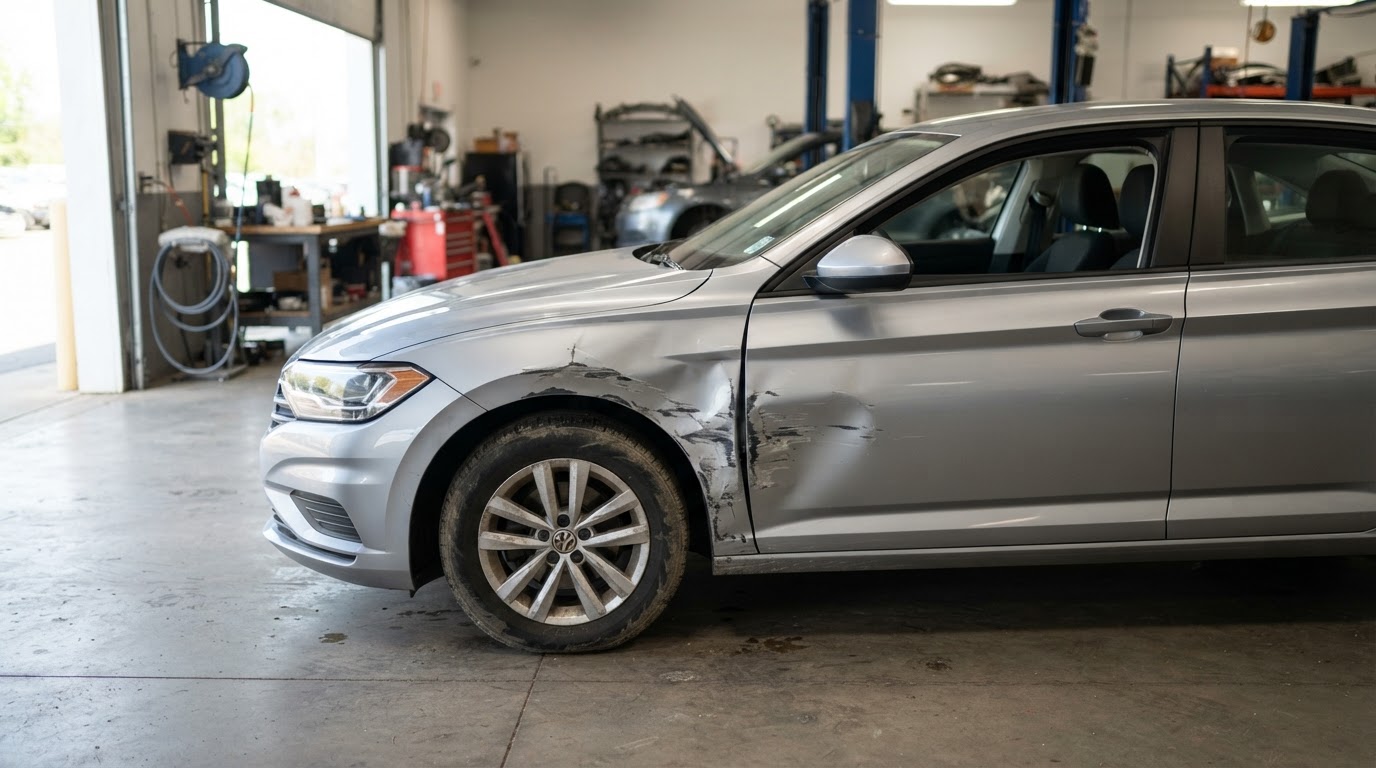
A dented fender does not automatically need replacement. Some fender damage can be repaired and refinished, while more extensive deformation, damaged mounting areas, or vehicle-specific repair requirements may make replacement the better option. The right call depends on the vehicle, the fender material, where the damage is located, and the condition of nearby components — not just how the dent looks at first glance.
Fender damage is common after parking lot bumps, minor front-corner collisions, and sideswipes, and the decision to repair or replace comes down to what is actually damaged. A small dent on an accessible panel may be very repairable, while a fender that is bent near the wheel, cracked, or pushed into surrounding panels may need replacement. Here is how that decision gets made.
Can a Damaged Car Fender Be Repaired?
Yes — many dented, scratched, and bent fenders can be repaired. When the damage is localized and the panel can be restored without compromising its fit or structure, a body shop can often work the metal back into shape, address the paint damage, and refinish the panel so it matches the rest of the vehicle.
Whether a fender can be repaired depends on a combination of factors:
- The depth and severity of the damage
- Where the damage is located on the panel
- The fender material (steel, aluminum, or composite)
- Whether the metal has stretched or creased
- The condition of the paint and finish
- The mounting points and adjacent structure
- Any previous repairs to the same area
- Applicable manufacturer repair procedures
We do not guarantee repairability without an inspection. A dent that looks small from the outside can involve stretched metal or a damaged mounting area that changes how the panel fits, while a dent that looks worse may be straightforward to repair. The actual condition of the panel — which only an assessment can confirm — drives the decision.
When Does a Fender Need Replacement?
Replacement may be the better option when the damage cannot be appropriately restored by repairing the existing panel. Conditions that can point toward replacement include:
- Severe deformation across a large area of the panel
- Extensive tearing or cracking of the material
- Missing material that cannot be rebuilt
- Damage to the mounting points that locate the fender
- Damage that cannot be restored without affecting fit or operation
- Manufacturer restrictions on repairing the panel
In some cases, the labor required to repair a severely damaged fender approaches or exceeds the labor to install a replacement, which can make replacement the more practical path. There are no universal dent-size or impact-speed thresholds — the decision is based on the actual condition of the panel and the applicable repair procedures for your vehicle.
Fender Repair vs. Replacement: What's the Difference?
Repair keeps your existing fender and restores it; replacement removes the damaged panel and installs a new one. Neither is automatically cheaper or better — each is appropriate for a different kind of damage.
| Factor | Fender repair | Fender replacement |
|---|---|---|
| Existing panel | Retained | Replaced |
| Typical damage | Repairable dents or scratches | Damage unsuitable for repair |
| Paintwork | May require refinishing | Often requires refinishing |
| Labor | Depends on the damage | Depends on installation |
| Parts | Existing panel used | Replacement panel required |
| Cost | Vehicle-specific | Vehicle-specific |
* Repair is not always cheaper, and replacement is not always necessary. The right choice depends on the damage and the vehicle.
Front Fender vs. Rear Fender: Why the Difference Matters
On many vehicles the front fenders are removable bolt-on panels, while the rear quarter panels — what many people call the "rear fenders" — are integrated into the body structure. That construction difference matters when it comes to repair and replacement.
Because a front fender can be unbolted, replacing one is often more straightforward: the damaged panel comes off and a new one goes on, followed by refinishing and reassembly of the adjacent parts. A rear quarter panel is typically welded into the vehicle, so repairing or replacing it can involve more complex body work — cutting, welding, and corrosion protection — to integrate the panel back into the structure.
Not every vehicle uses the same construction. Some models use composite or bolt-on rear panels, and some use different materials for front fenders. The point is that the same dent in two locations can involve very different repair processes, which is part of why an estimate is the useful next step.
Can a Dented Fender Be Repaired Without Painting?
Sometimes. Paintless dent repair (PDR) is a technique that can address certain dents from the back side of the panel without refinishing, which works best when the paint is intact, the dent is accessible, and the damage is suitable for the method. When it applies, PDR can be a faster, less involved option.
PDR is not a fit for every dent, however. Deep creases, stretched metal, damage near the edges or body lines of a panel, dents with cracked or damaged paint, and dents in areas that are difficult to reach from behind generally require conventional body repair and refinishing. We do not claim PDR as a Corner Collision Center service unless it is confirmed for your vehicle and damage — the appropriate method depends on the actual dent.
What If My Fender Is Bent Near the Wheel?
A fender bent near the wheel is a higher-priority concern than a purely cosmetic dent. Depending on how far the panel has shifted, a bent fender can:
- Rub against the tire during driving or turning
- Interfere with wheel movement or suspension travel
- Reduce clearance between the panel and the tire
- Damage the wheel-well liner or adjacent components
- Indicate that adjacent areas were also affected in the collision
We do not assume suspension damage exists just because the fender is bent — but if the fender is contacting the tire or interfering with wheel movement, we recommend not driving the vehicle until the condition is assessed. A tire rubbing against a sharp fender edge can damage the tire and create a safety concern.
Can Fender Damage Affect Wheel Alignment?
Cosmetic fender damage alone does not change wheel alignment, because the fender is a body panel rather than a steering or suspension component. But if the collision involved the wheel or suspension area, steering or suspension components may also have been affected — and those can change how the vehicle drives and aligns.
Symptoms that point toward having the vehicle assessed include:
- The vehicle pulling to one side
- Changes in steering feel or off-center steering
- Unusual or uneven tire wear
- A change in wheel position or stance
- Vibration through the steering wheel
An alignment adjusts wheel angles; it does not repair damaged suspension or steering components. If components were bent or shifted, those parts need to be addressed as part of the repair — an alignment alone is not a fix for damaged components.
Could There Be Hidden Damage Behind a Fender?
Possibly. The outer fender is only part of the assembly. Depending on the impact, collision damage can involve components behind or around the panel:
- Fender mounting brackets and attachment points
- The inner fender or wheel-well structure
- Wheel-well liners and splash shields
- Adjacent body panels and structure
- Structural areas that locate the fender
- Wiring routed through or near the fender
- Lighting components such as headlights or markers
- Suspension-related components, depending on the impact
Hidden damage does not always exist — a light parking lot scrape may be limited to the outer panel. But when a collision has enough force to dent a fender, the components behind it are worth checking. A professional assessment can help identify what was actually affected before repairs are authorized.
Can a Cracked or Torn Fender Be Repaired?
It depends on the material, the location, the severity, and the applicable repair procedures. Metal fenders and plastic or composite panels are handled differently, and the right approach is vehicle-specific.
Some cracks and tears can be addressed with repair material or, where appropriate, welding on metal panels — but others cannot be restored reliably and call for replacement. Without vehicle-specific information, we do not prescribe a particular method such as welding or plastic repair. The condition of the panel and the manufacturer's procedures determine whether a crack or tear can be repaired or whether the fender should be replaced.
How Much Does Fender Repair Cost?
There is no single fender repair cost, and we do not quote prices online — an accurate estimate requires assessing the actual damage in person. The cost depends on a combination of factors:
| Cost factor | Why it affects the price |
|---|---|
| Vehicle make & model | Different vehicles use different materials and part costs |
| Fender material | Steel, aluminum, and composite panels require different procedures |
| Dent severity | Deeper deformation means more repair labor |
| Paint damage | Scratched or cracked paint adds refinishing work |
| Repair vs. replacement | The chosen method changes labor and parts |
| Replacement parts | A new fender adds part cost if replacement is needed |
| Refinishing & blending | Paint work and adjacent blending add labor where needed |
| Hidden / adjacent damage | Damage behind the panel can add scope once discovered |
| Mounting components | Brackets, clips, and liners may need repair or replacement |
* The most accurate way to know the cost is to have the actual damage assessed in person.
Is It Cheaper to Repair or Replace a Fender?
Not automatically. For a small dent, repairing the existing fender is usually the more economical option. But when the damage is extensive, the labor required to repair a severely deformed panel — plus the refinishing — can approach or exceed the cost of installing a replacement fender.
Replacement costs can include the part itself, removal and installation labor, paint and refinishing, any additional components that must be transferred or replaced, and calibration or related procedures where applicable. Rather than assuming one option is cheaper, a repair estimate compares the appropriate repair methods for your specific vehicle and damage so you can decide with real numbers.
Will the Paint Match After Fender Repair or Replacement?
Paint matching is more involved than reading a code off a label. A collision repair facility may use several tools to match the existing finish:
- The vehicle's paint code and paint information
- Color evaluation of the existing finish
- Paint-mixing systems to formulate the color
- Test panels or spray-out processes where appropriate
- Blending into adjacent panels when needed
Even with all of that, an exact, undetectable match under every lighting condition cannot be guaranteed. Existing paint condition, color variation between model years, sun fading, and the repair itself can all affect how closely the refinished area matches the rest of the vehicle. At Corner Collision Center, our fender repair process includes computerized color-matching and refinishing to help the repaired or replaced fender blend with your vehicle's existing finish.
Will Insurance Cover Fender Damage?
Coverage depends on your policy, the applicable coverage, who was at fault, your deductible, the documentation you have, and the insurer's review of the estimate. A body shop cannot guarantee insurance approval or payment — the claim is reviewed by the insurer based on your policy.
If you were not at fault and the other driver's insurer accepts liability, that third-party liability coverage may handle the repair without your own collision deductible applying. If you use your own collision coverage, your deductible generally applies regardless of fault, though it may be recoverable through subrogation. For a full walkthrough of how deductibles work after a collision, see our article on who pays the deductible after a car accident in California.
What If Insurance Wants Repair but the Body Shop Recommends Replacement?
Differences between an insurance estimate and a body shop's recommendation can come up for several reasons:
- Additional damage that was not visible during the initial estimate
- A different repairability assessment after disassembly
- Manufacturer repair procedures that were not in the initial estimate
- Parts requirements discovered once the panel was opened up
When that happens, the body shop can prepare a supplemental estimate documenting the additional damage or needed work and submit it to the insurer for review. The supplement process exists precisely because an initial visual estimate may not capture everything. For more on how that works, see our article on insurance estimates being lower than body shop estimates.
Can I Drive With a Damaged Fender?
A small cosmetic dent is different from damage that affects how the vehicle operates. Before driving, consider whether any of the following apply:
- The fender is touching or rubbing the tire
- Loose components that could shift or fall off
- Sharp edges that could cut tires or cause injury
- Damaged lighting, such as a broken headlight or marker light
- Steering or suspension changes after the impact
- Significant damage to adjacent panels or structure
We cannot determine whether a specific vehicle is safe to drive without inspecting it. If the fender is contacting the tire, a light is broken, or the vehicle is not driving the way it did before the collision, have it assessed before driving it further. For a broader guide to when a damaged vehicle is safe to drive, see our article on whether your car is safe to drive after an accident.
How Does a Body Shop Decide Whether to Repair or Replace a Fender?
The decision is based on an assessment of the actual damage. A simplified version of that process looks like this:
- 1Inspect the visible damage on the fender.
- 2Identify the panel material and construction.
- 3Evaluate the deformation and the paint condition.
- 4Check the mounting areas and attachment points.
- 5Assess any nearby collision damage to adjacent panels.
- 6Review applicable manufacturer repair procedures.
- 7Determine the appropriate repair or replacement options.
- 8Prepare a repair estimate for the vehicle.
Not every inspection involves complete disassembly. A small dent may be assessable from the outside, while more involved damage may require removing the fender or adjacent parts to see what is behind it. The scope of the assessment matches the damage.
Fender Repair in Gardena, California
If your fender was damaged in a parking lot, a minor front-corner collision, or a sideswipe in Gardena or the surrounding South Bay and Los Angeles area, Corner Collision Center can assess the collision damage and explain the repair options for your vehicle.
Corner Collision Center
1311 W 130th St Unit 7
Gardena, CA 90247
Phone: (310) 678-5596
BAR ID: ARD 312893
Our services include fender repair, collision repair, bumper repair, paint matching and refinishing, structural repair, and insurance claim assistance. We assess the damage first so you understand whether your fender can be repaired or should be replaced — and what either option involves for your vehicle.
Damaged Fender? Find Out Whether Repair or Replacement Makes Sense.
Whether your fender has a deep dent, scraped paint, or damage near the wheel, Corner Collision Center in Gardena can assess the collision damage and explain the repair options for your vehicle.
Frequently Asked Questions
Can a dented fender be repaired?
Yes. Many dented fenders can be repaired when the damage is localized and the panel can be restored without compromising its structure. The repairability depends on the dent depth, location, the fender material, whether the paint is intact, the mounting areas, and applicable manufacturer procedures. Not every dent can be repaired — some damage requires replacement — which is why an inspection is the right first step.
Does a bent fender need replacement?
Not always. A bent fender may be repairable if the deformation can be corrected and the mounting areas are sound. Replacement may be more appropriate when the fender is severely deformed, torn, missing material, or has damaged mounting points, or when manufacturer procedures restrict repair. The right call depends on the actual condition of the panel.
Can a front fender be replaced?
Yes. On many vehicles the front fender is a bolt-on panel, which generally makes replacement more straightforward than a welded structural panel. Replacement involves removing the damaged panel, installing a new fender, refinishing it, and reassembling adjacent components. Whether repair or replacement makes sense depends on the damage.
Is a rear fender harder to repair?
What many people call a 'rear fender' is usually the rear quarter panel, which is commonly integrated into the body structure rather than a bolt-on part. Because of that construction, repairing or replacing a rear quarter panel can involve more complex body work than a removable front fender. The specifics depend on the vehicle.
What is the difference between a fender and a quarter panel?
A front fender is typically a removable panel bolted to the front of the vehicle over the front wheels. A quarter panel is the rear body section over the rear wheels and is usually welded into the vehicle's structure. Quarter panel repair or replacement can be more involved than front fender work.
Can fender dents be repaired without painting?
Sometimes. Paintless dent repair may be an option for certain dents when the paint is intact and the damage is accessible and suitable for the technique. Deep creases, stretched metal, dents near edges or body lines, and damage with cracked paint generally require conventional body repair and refinishing. The right method depends on the actual dent.
How much does fender repair cost?
There is no single fender repair cost. The price depends on the vehicle make and model, the fender material, dent severity, paint damage, repair labor, any replacement parts, refinishing, blending adjacent panels where needed, hidden damage, and mounting components. We do not quote prices online — an accurate estimate requires assessing the damage in person.
How much does fender replacement cost?
Fender replacement cost depends on the part, removal and installation labor, paint and refinishing, any additional components that must be transferred or replaced, and calibration or related procedures where applicable. Because those factors vary by vehicle and damage, a specific cost requires an in-person estimate.
Is repairing a fender cheaper than replacing it?
Not automatically. For a small dent, repairing the existing fender is usually more economical. But for extensive damage, the labor to repair a severely deformed panel — plus refinishing — can approach or exceed the cost of installing a replacement. The right comparison is between the appropriate repair methods for your specific vehicle and damage.
Can fender damage affect wheel alignment?
Cosmetic fender damage alone does not change wheel alignment. However, if the collision involved the wheel or suspension area, steering or suspension components may also be affected. Symptoms like pulling, steering changes, unusual tire wear, or vibration should be assessed. An alignment adjusts angles — it does not repair damaged suspension components.
Can I drive with a bent fender?
A small cosmetic dent is different from a fender that touches the tire, interferes with wheel movement, has loose or sharp components, damaged lighting, or steering and suspension changes. If the fender contacts the tire or affects safe operation, do not drive it until the condition is assessed. We cannot determine whether a specific vehicle is safe to drive without inspecting it.
Can a damaged fender rub against a tire?
Yes. A bent fender near the wheel can reduce clearance and rub against the tire, potentially damaging the tire or wheel-well liner. If your fender is contacting the tire or interfering with wheel movement, have it assessed before driving.
Could there be hidden damage behind a fender?
Possibly. Collision damage can involve fender mounting brackets, inner fender areas, wheel-well liners, adjacent panels, structural areas, wiring, lighting components, and suspension-related parts depending on the impact. Hidden damage does not always exist, which is why a professional assessment may be necessary to know what was actually affected.
Will insurance cover fender replacement?
Coverage depends on your policy, the applicable coverage, who was at fault, your deductible, and the insurer's review of the estimate. A body shop cannot guarantee insurance approval or payment. If you were not at fault, your deductible may be recoverable through subrogation in some cases, but that is not guaranteed.
Will new fender paint match the car?
A collision repair facility can use your vehicle's paint information, color evaluation, and paint-mixing systems to match the existing finish, and may blend adjacent panels where appropriate. Existing paint condition, color variation between model years, and the repair itself can all affect how closely the refinished area matches — so a perfect, undetectable match under every condition cannot be guaranteed.
How long does fender repair take?
There is no universal timeline. Fender repair time depends on the damage, whether the fender is repaired or replaced, parts availability, refinishing, and any hidden or adjacent damage. An accurate estimate of the repair timeline requires assessing the damage and confirming parts for your specific vehicle.
Can I choose my own body shop?
Yes. California Insurance Code Section 758.5 establishes a consumer's right to choose the repair facility for insured vehicle repairs, regardless of any insurer recommendation. An insurer can provide information about a shop, but generally cannot require you to use a specific shop. See our article on choosing your own body shop for more detail.
Where can I get fender repair in Gardena, CA?
Corner Collision Center, located at 1311 W 130th St Unit 7, Gardena, CA 90247, provides fender repair, collision repair, bumper repair, paint matching and refinishing, structural repair, and insurance claim assistance. Call (310) 678-5596 to request a repair estimate.